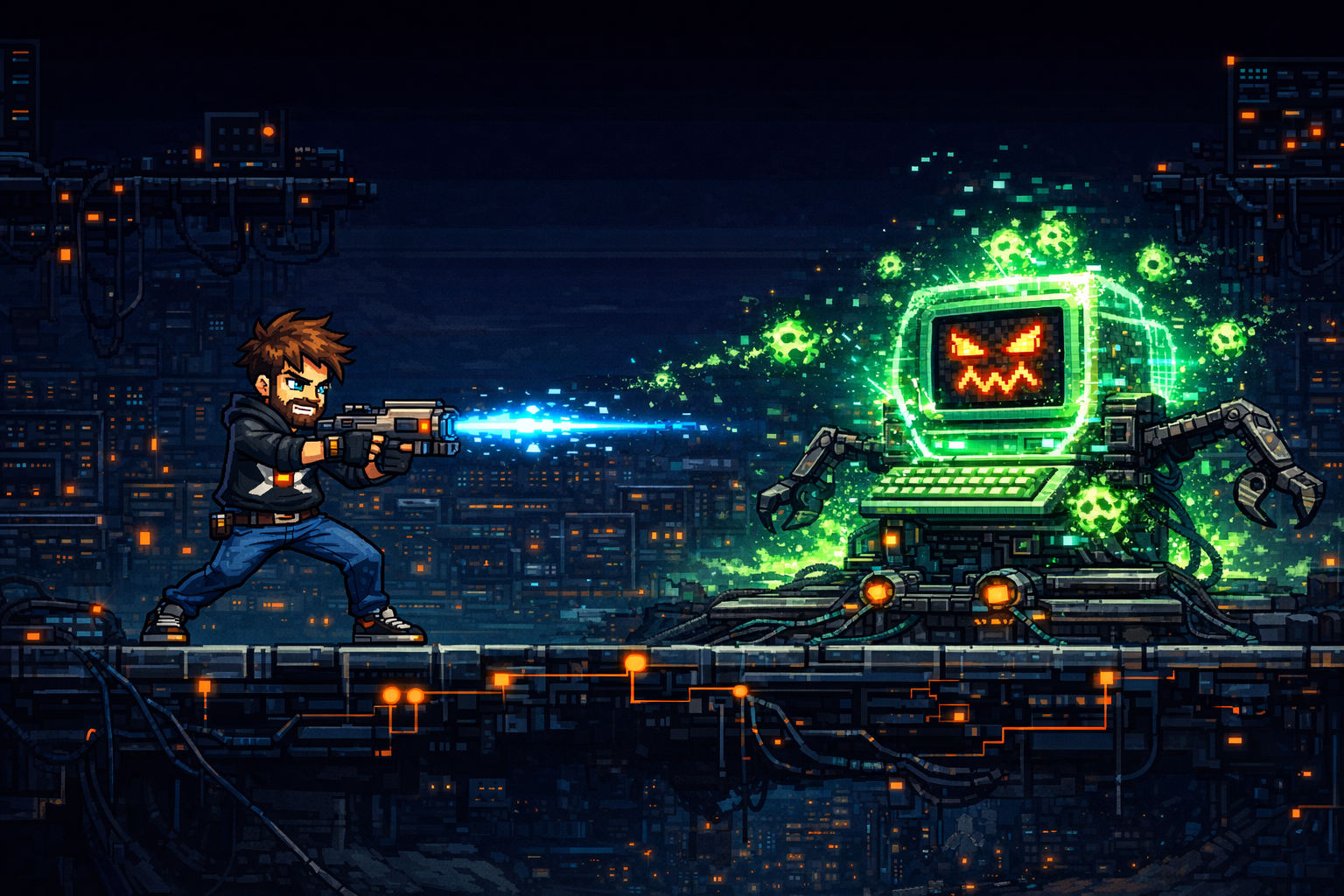
Unlike a Ghost Device, the Rogue Terminal is not fully invisible. It exists physically in the level, but its true threat is not immediately obvious until the player gets close or reveals its activity through scanning.
Rogue Terminal
A corrupted machine hidden inside the fractured inventory layer. Rogue Terminals represent devices that should be known, tracked, and controlled — but instead operate outside visibility, spreading instability across the environment.
What is a Rogue Terminal?
The Rogue Terminal is a hostile legacy system that has slipped outside inventory control. It appears as a corrupted workstation or terminal that has become partially weaponized by the unstable network around it.
It represents a device that should have been cataloged and managed, but instead became unstable, hostile, and disconnected from trusted inventory records.
Rogue Terminals work well as fixed or semi-fixed enemies that control space, forcing the player to respect range, timing, and movement.
Why it is dangerous
Rogue Terminals control parts of the level by firing bursts, corrupting nearby space, or forcing the player into narrow movement windows.
They do not need to chase the player to be dangerous. By holding position and attacking in patterns, they turn safe pathways into threat zones.
They symbolize known-looking systems that are actually compromised, outdated, or misidentified — devices that quietly create risk because no one realizes what they have become.
Gameplay mechanics
The Rogue Terminal can remain fixed in place or move slightly along a platform or mechanical base, making it feel heavy and rooted while still interacting with the environment.
It attacks by firing corrupted bursts or data fragments in timed sequences. This gives the player a rhythm to read, dodge, duck under, or jump over.
Scanning can reveal weak points, disable a shield state, or interrupt a hidden attack cycle. This reinforces the chapter theme that visibility must come before control.
Physics and combat behavior
The Rogue Terminal should have a grounded collision body, allowing it to occupy physical space on a platform and block the player’s movement when approached directly.
It should feel more massive than the player, with slower movement, little or no knockback, and attacks that make it behave like a defensive obstacle as much as an enemy.
Because the Operator can run, jump, duck, and fire, the Rogue Terminal should telegraph its attacks clearly so the player can react with movement and timing rather than guesswork.
Why it fits Chapter 1
Chapter 1 is about hidden devices, incomplete records, and systems outside visibility. The Rogue Terminal expands that idea by showing that some assets are not just missing — some are visible but misunderstood, outdated, or quietly dangerous.
A Rogue Terminal may appear to be just another machine in the environment until scanning or proximity reveals that it is active and hostile.
It embodies the idea of assets that exist in poor inventory states — missing ownership, missing controls, or mismatched data.
Defeating a Rogue Terminal is not only combat. It is an act of restoring order to the inventory layer, making the environment safer and more visible.