Unowned asset
The Orphan Node represents a device or system that remains active in the environment without clear stewardship, making it difficult to trust, manage, or contain.
A drifting system fragment with no ownership, no accountability, and no stable place in the inventory layer. Orphan Nodes disrupt scanning, interfere with movement, and turn the environment itself into a hazard.
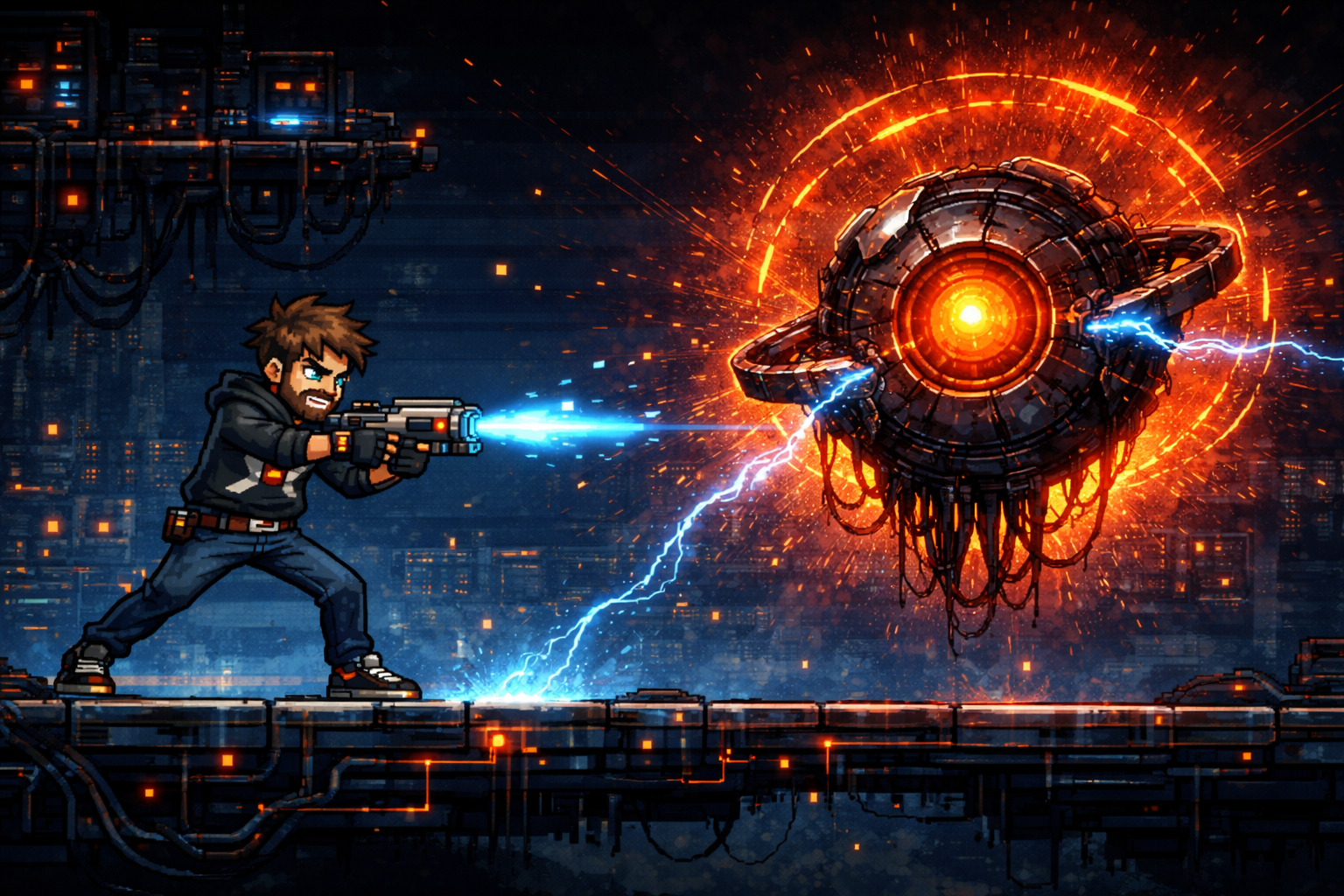
The Orphan Node is a detached infrastructure fragment — a system that still exists, still functions, and still causes risk, but has no clear owner or accountability path. It floats through the inventory layer like a loose piece of hostile infrastructure.
The Orphan Node represents a device or system that remains active in the environment without clear stewardship, making it difficult to trust, manage, or contain.
Unlike grounded enemies, the Orphan Node appears as a drifting, unstable fragment of the environment itself — loose, unanchored, and dangerous.
It expands Chapter 1 beyond ground-level danger by occupying the air above the player and forcing more vertical awareness during combat.
Orphan Nodes attack the level itself by sending unstable pulses into nearby platforms and surfaces, turning safe spaces into temporary hazards.
Because they operate without clear ownership or control, they symbolize the kind of unmanaged risk that persists simply because no one is responsible for it.
They force the player to manage threats above the normal combat plane, changing jump timing, spacing, and firing rhythm.
Orphan Nodes drift left and right through a defined airspace, giving them a floating presence that feels disconnected from the rules of grounded enemies.
They emit unstable pulses that can temporarily interfere with platforms, scan zones, or nearby safe positions, forcing the player to reposition.
Their position above the battlefield pushes the player to aim upward, jump more carefully, and treat the whole arena as contested space.
The Orphan Node does not run along the ground. It hovers with a bounded drift pattern, making it visually and mechanically distinct from the Operator and other grounded threats.
It should feel less massive than a Rogue Terminal, but still substantial enough to read clearly as a physical threat occupying real space in the scene.
Instead of pure direct damage, the Orphan Node is strongest when altering the environment around the player, shaping movement decisions through interference and timing.
Chapter 1 is about hidden devices, incomplete records, and systems outside visibility. The Orphan Node extends that theme by representing assets that are present and active, but disconnected from ownership and accountability. It shows that visibility alone is not enough — systems also need stewardship.
The Orphan Node is visible, but still dangerous because it exists outside the boundaries of responsibility and control.
Its disruption effects make the inventory layer feel unstable, reinforcing the idea that unowned systems damage the environment around them.
Alongside Ghost Devices, Rogue Terminals, and Duplicate Entities, the Orphan Node completes Chapter 1’s full picture of asset-management failure.